
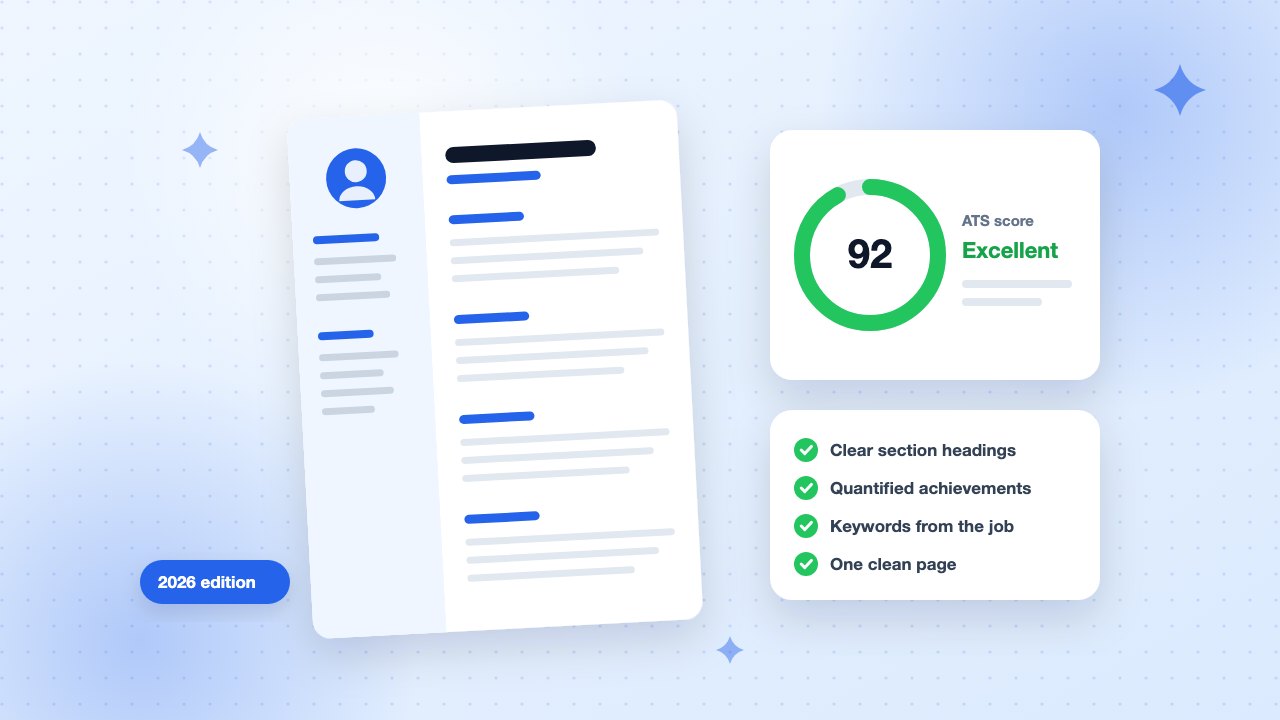
Recruiters often spend less than ten seconds on a first look at a resume. In that time they want to know three things: what you do, how well you do it, and whether you fit this role. This guide walks you through every section so your resume answers those questions fast.
1. Choose the right format
| Format | Best for | How it works |
|---|---|---|
| Reverse-chronological | Most people | Latest job first. Recruiters and ATS prefer it. |
| Hybrid (combination) | Career changers, specialists | A strong skills section up top, followed by experience. |
| Functional | Rarely recommended | Groups skills and hides the timeline, which can raise questions. |
If you’re not sure, choose reverse-chronological.
2. Get the layout basics right
- Length: one page for under ~8 years of experience; two pages for senior roles.
- Fonts: a clean sans-serif at 10–12pt body, 14–18pt for your name.
- White space: margins of at least 0.5 inch and space between sections.
- Consistency: same date format, same bullet style, same heading style throughout.
A good template handles all of this for you.
3. Contact information
Name, phone number, professional email, city and country (a full street address isn’t needed), and a LinkedIn or portfolio link. Leave out date of birth, marital status, and ID numbers unless they’re standard in your country.
4. Write a summary that sells
Two or three lines that combine your title + years of experience + top skills + a standout result.
Full-stack developer with 5 years of experience building React and Node.js applications for e-commerce brands. Cut page load time by 45% and led a checkout rebuild that increased conversion by 12%.
Freshers can write a short objective focused on skills and goals instead. See more profile summary examples.
5. Turn duties into achievements
This is the most important part of your resume. Use this formula for every bullet:
Action verb + what you did + measurable result
“Automated monthly reporting in Power BI, saving the finance team 20 hours per month.”
| Before | After |
|---|---|
| Handled customer complaints. | Resolved 40+ customer escalations weekly, raising CSAT from 82% to 94%. |
| Worked on the company website. | Redesigned the company website, increasing organic traffic 60% in six months. |
| Managed a team. | Led a team of 8 engineers and delivered 3 major releases ahead of schedule. |
No exact numbers? Estimate honestly (“about 30%”) or use scale: number of clients, team size, budget, frequency.
Strong action verbs
Leadership: led, directed, mentored, coordinated. Growth: increased, expanded, accelerated, launched. Efficiency: streamlined, automated, reduced, consolidated. Creation: designed, built, developed, introduced.
6. Skills: be specific
List hard skills and tools that match the job, such as “Python, Tableau, A/B testing, Jira.” Group them if the list is long (Languages, Tools, Methods). Prove soft skills in your bullets instead of listing words like “team player.”
7. Education and certifications
Degree, school, and year. Add GPA, honors, or relevant coursework only if you’re early in your career. Put recent, relevant certifications (AWS, PMP, Google Analytics) in their own section.
8. Optional sections that add value
- Projects: essential for students, developers, and designers
- Awards and achievements
- Languages, with proficiency level
- Volunteering, especially if it shows relevant skills
9. Make it ATS-friendly
Many employers use applicant tracking systems to store and search resumes. Help them read yours:
- Use standard headings: “Experience,” “Education,” “Skills.”
- Avoid putting text inside images, charts, or text boxes.
- Use keywords from the job description naturally.
- Submit a text-based PDF unless asked for another format.
Read more in our ATS-friendly resume guide and learn how to tailor your resume to any job.
10. Final checklist
- Tailored the summary and top bullets to this job
- Every bullet starts with an action verb
- At least half of your bullets include a number or result
- No spelling mistakes (read it backwards, or out loud)
- Consistent dates, fonts, and spacing
- Contact details correct and clickable
- Saved as
Firstname-Lastname-Resume.pdf
Put it into practice
The fastest way to apply this guide is to build as you read. Open the resume builder, choose a template, use AI suggestions to sharpen your bullets, and check your ATS score before you download. For inspiration, browse resume examples by industry.