
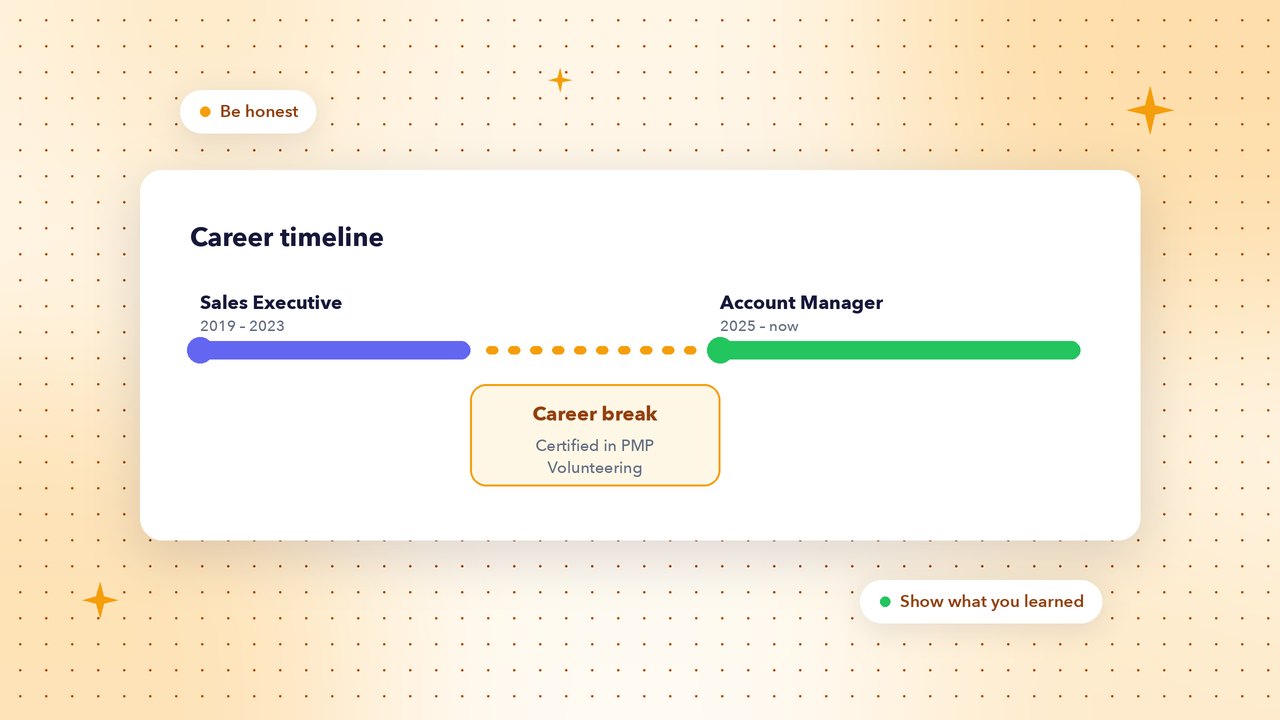
Layoffs, health, caring for family, further study, relocation, starting a business — there are many good reasons for a break in your career. Employment gaps are far more common today than they were a decade ago, and most recruiters understand that. What matters is how you present the gap.
Do you need to explain a gap?
- Under 3–6 months: usually no explanation needed. Job searches take time.
- 6–12 months: a short, honest line on your resume or cover letter helps.
- Over a year: address it directly and show what you did or learned during that time.
How to show a gap on your resume
1. Use years instead of months (for older gaps)
If a short gap happened several jobs ago, listing “2019 – 2022” instead of “Mar 2019 – Jan 2022” is common and acceptable. Don’t use this trick to hide a recent or long gap — it can look evasive.
2. Add the gap as its own entry
For longer breaks, list the gap like a role with one or two lines of context:
Career Break — Family Care | Jan 2024 – Mar 2025
Full-time caregiver for a family member. Completed the Google Project Management Certificate and volunteered as treasurer for a local residents’ association.
3. Highlight what you did during the gap
- Courses and certifications
- Freelance, contract or part-time work
- Volunteering or community roles
- Personal projects, a blog or a portfolio
- Running a small business or side project
4. Lead with skills
A strong summary and skills section at the top keeps the focus on what you can do. A hybrid resume format works well here — see resume formats explained.
Honest wording for common reasons
| Reason | How to phrase it |
|---|---|
| Layoff | “Position eliminated during company restructuring.” |
| Parenting | “Career break to care for my young children; now ready to return full-time.” |
| Health | “Took time off to address a health matter, which is now fully resolved.” |
| Further study | “Completed an MBA / full-time certification programme.” |
| Relocation | “Relocated to Pune with my family and set up our new home.” |
| Travel or personal time | “Planned sabbatical to travel and recharge, during which I…” |
You don’t have to share private details, especially about health. A short, positive statement is enough.
Explaining the gap in an interview
Keep your answer to 30–60 seconds and follow three steps:
- State the reason briefly and honestly.
- Mention what you did to stay sharp — courses, projects, volunteering.
- Pivot to the future: why you’re ready now and excited about this role.
Sample answer: “After my role was eliminated in a restructuring, I took the opportunity to complete a data analytics certification and built three dashboards for local non-profits. It confirmed that analytics is where I want to grow, which is why this analyst role is such a good fit.”
What not to do
- Don’t lie about dates — background checks will reveal it.
- Don’t sound apologetic or negative about past employers.
- Don’t over-explain. One or two sentences is plenty.
You can also mention your gap briefly in your cover letter — our cover letter guide shows how. Then build a fresh, confident resume with our resume builder.